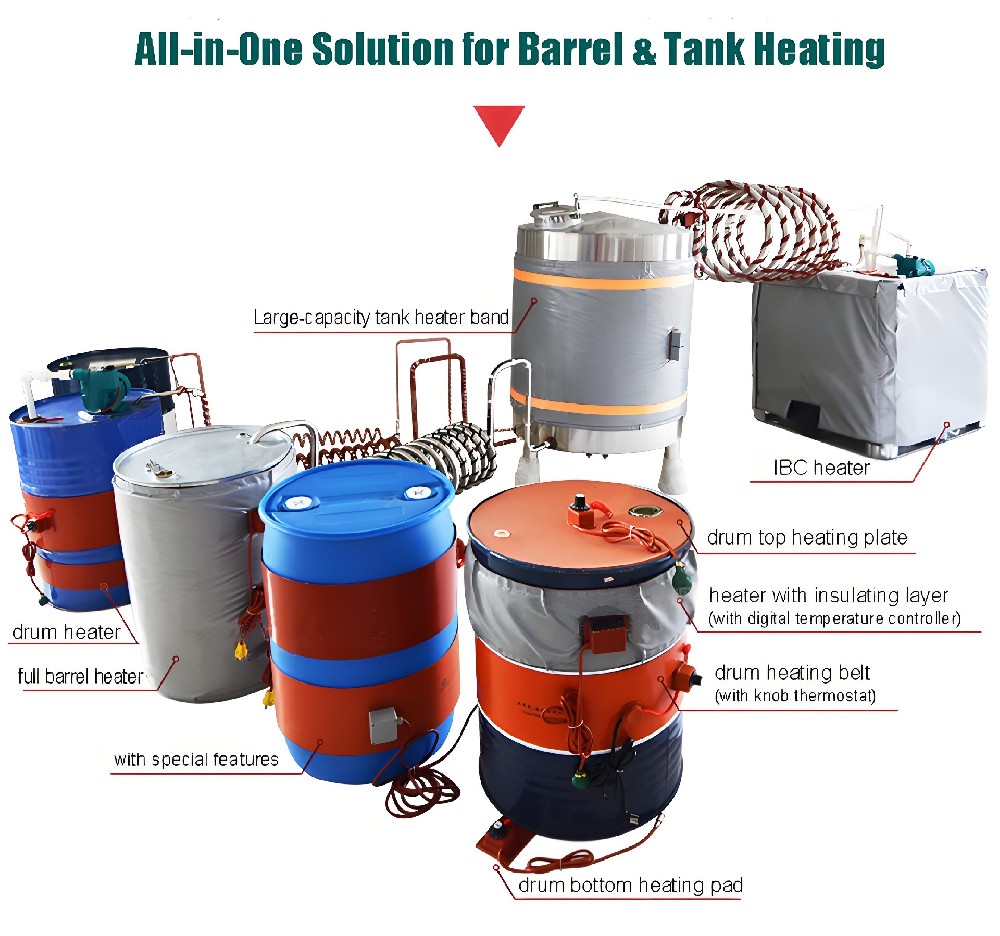
From standard drum heating belts and various tank heating belts to a wide range of accessory upgrades, our advanced production lines enable high-volume manufacturing.
With extensive export experience, we are capable of mass-producing heating belts featuring US, European, or Australian standard plugs.
We support custom orders based on provided drawings for any specific size or type.
Applications for Drum Heating Belts
Chemical Industry: Used to heat high-viscosity chemical raw materials—such as resins, asphalt, and lubricants—to reduce viscosity and facilitate pumping, mixing, and processing. Commonly found in the production stages of paints, plastics, and lubricants.
**Food Processing Industry:** Heats food-grade media—such as cooking oils, syrups, and honey—to ensure material fluidity and meet process requirements for filling, blending, and other operations, while adhering to food-grade hygiene standards.
Energy Industry: During the storage and transport of crude oil and refined fuels, these belts heat the contents of drums to prevent solidification at low temperatures, ensuring the smooth transfer and unloading of petroleum products. This is particularly vital in cold northern regions or on offshore platforms.
Laboratories & Small-Batch Production: In laboratory-scale trials or small-batch manufacturing settings, these belts heat samples or small quantities of materials within drums to meet specific temperature requirements for experiments or limited-scale production runs.
Applications for IBC Heating Belts
Large-Scale Warehousing & Logistics: At major chemical storage facilities and port terminals, these belts heat chemical raw materials, refined fuels, and other contents within IBC totes. This ensures materials maintain appropriate fluidity during storage and transit, preventing issues such as solidification or pipeline blockages caused by low temperatures.
Continuous Production Processes: In continuous production lines within the chemical, pharmaceutical, and similar industries, IBC totes often serve as intermediate storage vessels. Heating belts maintain material temperatures to ensure the continuity and stability of the production flow, preventing temperature fluctuations from compromising product quality.
Operations in Special Environments: In scenarios involving outdoor low-temperature environments or polar operations, these belts provide continuous heating for materials stored in IBC totes, ensuring their usability. This is commonly seen in specialized operations such as petroleum exploration and polar scientific research.
Hazardous Materials Handling: For hazardous chemicals characterized by low-temperature solidification, IBC heating belts enable the heating of materials under safe and controlled conditions, thereby facilitating their safe handling and transfer. Furthermore, these devices must incorporate safety features—such as explosion protection—and comply with all relevant safety regulations.