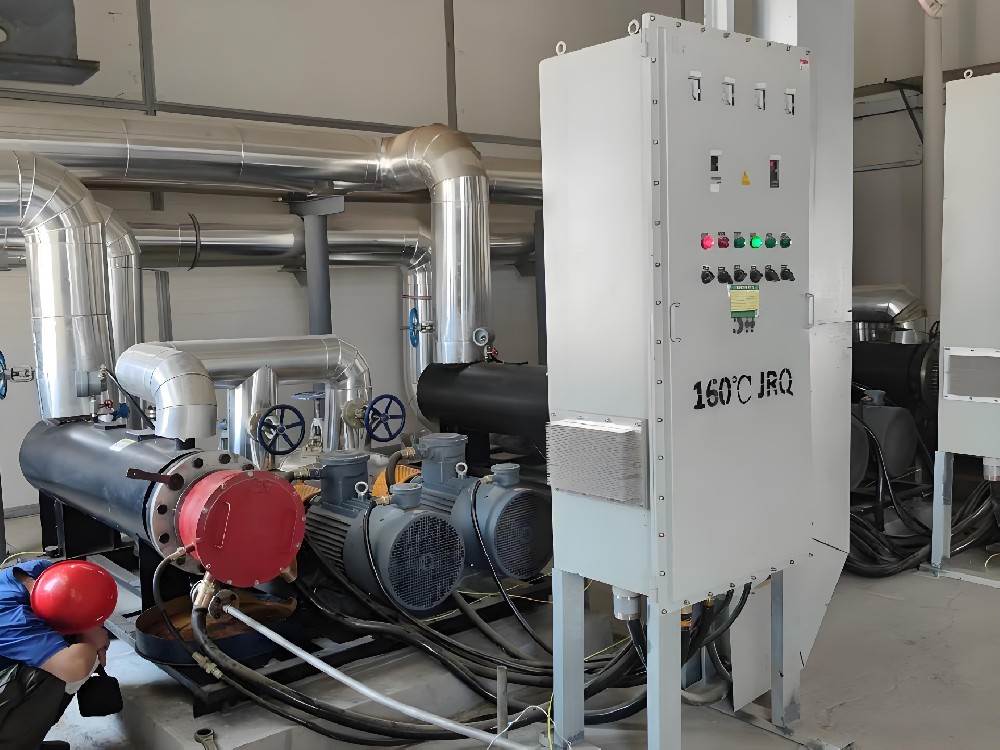
I. Scenarios for Chemical Material Transport and Thermal Insulation
In chemical production, many materials are prone to solidification or increased viscosity in low-temperature environments, leading to blockages in transport pipelines and disrupting the smooth flow of production processes. Chemical electric heaters effectively resolve this challenge and are widely utilized in the transport and thermal insulation stages of various chemical materials.
For hydrocarbons—such as crude oil, heavy oil, and fuel oil—within the petrochemical industry, electric heaters facilitate long-distance pipeline transport by employing "pipeline tracing" (companion heating) techniques. This method continuously supplies heat to the materials, thereby maintaining their fluidity. For instance, in crude oil pipelines, electric heaters maintain the oil temperature within an optimal range, preventing the solidification of waxy components and ensuring transport efficiency. In the field of fine chemicals, certain viscous chemical intermediates and resinous materials also require heating and thermal insulation within transport pipelines—facilitated by electric heaters—to prevent transport failures caused by temperature drops.
Furthermore, electric heaters play a crucial role in the associated piping systems of chemical storage tanks. They can preheat materials as they exit storage tanks, ensuring that the material temperature meets specific process requirements upon entering subsequent production stages.
II. Scenarios for Gas Heating and Pre-treatment
In chemical production, numerous processes require the heating and pre-treatment of gases; consequently, chemical electric heaters are widely applied in this domain.
In the treatment of chemical waste gases, heating the gas to a specific temperature is often necessary to enhance treatment efficiency. Electric heaters can heat waste gases containing volatile organic compounds (VOCs), bringing them to the optimal reaction temperature required for subsequent treatment processes—such as catalytic combustion or adsorption-desorption—thereby improving waste gas purification results. For example, in the waste gas treatment systems of the coating industry, preheated waste gas establishes better contact with catalysts, facilitating the efficient decomposition of organic compounds.
Electric heaters also play a functional role in the gas transport and utilization stages of chemical production. For instance, they can heat process gases—such as nitrogen or air—to meet the specific temperature requirements of particular chemical reactions. In certain chemical production processes that require inert gas protection, preheated nitrogen serves as a more effective protective medium, preventing the oxidation of materials. Furthermore, in the field of natural gas chemical processing, electric heaters can be utilized to preheat natural gas, thereby enhancing its reactivity in subsequent processing stages.
III. Explosion-Proof Applications in Specialized Environments
The chemical industry features numerous locations with inherent flammability and explosion risks—such as chemical workshops, oil and gas storage facilities, and offshore oil platforms—where equipment is subject to extremely stringent requirements regarding explosion-proof performance. Thanks to their specialized structural design and robust safety features, explosion-proof electric heaters for chemical applications have found widespread use in these hazardous environments.
Explosion-proof electric heaters are equipped with explosion-proof enclosures and isolation devices that comply with national standards. These features effectively isolate or eliminate any internal electrical sparks that may arise, thereby preventing the ignition of flammable or explosive gases and dust present in the surrounding atmosphere. On offshore oil platforms, explosion-proof electric heaters are employed to heat media such as crude oil and associated gas, ensuring the safe execution of extraction and transportation operations. Within explosion-proof workshops dedicated to chemical manufacturing, these heaters serve as a safe and reliable heat source for various processes involving hazardous chemical materials, such as heating and chemical reactions.
Moreover, explosion-proof electric heaters incorporate multiple safety protection mechanisms—such as over-temperature protection and pressure monitoring—that automatically cut off the power supply in the event of equipment anomalies. This capability effectively prevents safety accidents, providing a robust guarantee for safe production within the chemical industry.
IV. Temperature Control in Chemical Reaction Processes
Chemical reactions often impose strict requirements regarding temperature conditions; consequently, chemical electric heaters—distinguished by their precise temperature control capabilities—have become indispensable equipment in chemical reaction processes.
In reactor systems, electric heaters provide the appropriate temperature environment for reactions through a variety of heating modes. Flange-mounted tubular heating elements, inserted into the reactor jacket, heat a thermal fluid (such as thermal oil); this configuration enables rapid heating of the reactor vessel, thereby meeting the requirements of chemical reactions that demand a quick start-up. Alternatively, far-infrared electric heating units can be wrapped around the bottom and lower-to-mid sections of the reactor vessel to provide heat. This method ensures a smooth and rapid heating process with uniform heat distribution, effectively mitigating the risk of material carbonization. It is particularly well-suited for chemical synthesis reactions that are temperature-sensitive or involve demanding reaction conditions—such as the synthesis of pharmaceutical intermediates and the preparation of fine chemicals. In these applications, electric heaters work in conjunction with PID adaptive control technology to precisely maintain the reaction temperature within the specified range, thereby ensuring high reaction conversion rates and superior product quality. Furthermore, in certain continuous chemical reaction processes, a circulating electric heater serves as a stable heat source for the reaction system. It functions by heating a circulating medium—such as thermal oil—and continuously transferring that heat to the reaction system, thereby maintaining temperature stability throughout the entire reaction process. In large-scale chemical polymerization reactions, for instance, this ensures that the reaction proceeds uniformly and stably.